For decades, the bachelor’s degree was the gold standard of talent screening: a seemingly reliable shorthand for readiness, intelligence, and capability. But in 2026 and beyond, rigid degree requirements are increasingly doing more harm than good for talent acquisition. They shrink talent pools, limit diversity, and often overlook candidates who have real, demonstrated ability to do the job.
If your organization still relies heavily on a college degree as a gatekeeping criterion, now is the time to rethink that approach. Skills-based hiring (where capabilities matter more than credentials) isn’t just trendy HR jargon; it’s becoming a strategic advantage in a tight labor market and a skills-driven economy.
Traditional degree requirements eliminate a huge swath of capable candidates, including people trained through alternative pathways like bootcamps, vocational programs, certifications, military service, self-directed learning, and real-world experience. The Burning Glass Institute estimates that millions of qualified workers are excluded from job opportunities simply because they lack a degree.
But the value of a degree in predicting job performance is weaker than once believed. McKinsey research shows that hiring for skills is up to five times more predictive of job success than hiring based on formal education alone.
Today’s employers are starting to take notice — and act.
Here’s the story that the data tells about what’s already underway:
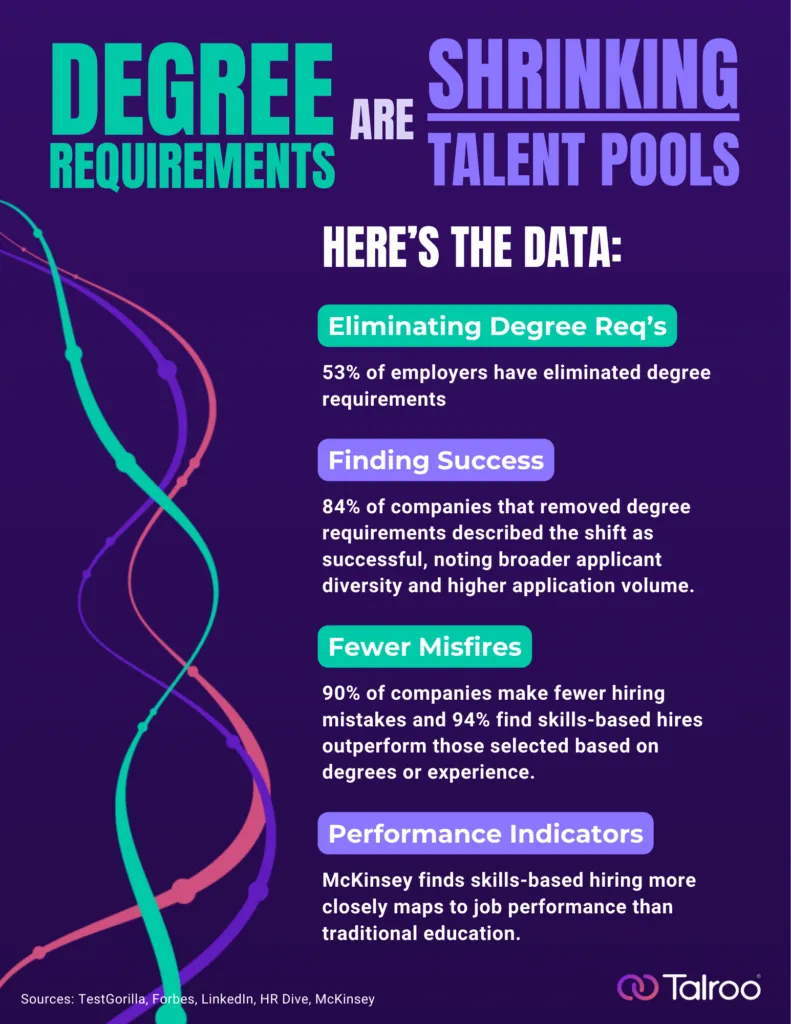
Taken together, this data paints a clear picture: job performance and organizational success are increasingly tied to what candidates can do, not just what credentials they carry.
Shifting from degree requirements to skills-based hiring is not simply removing a checkbox. It’s about rethinking your entire talent funnel, from job descriptions to evaluation methods.
Here’s what effective skills-first hiring looks like in practice:
Begin by pinpointing the actual competencies required for success in a role. Ask yourself:
This means focusing on outcomes such as problem-solving, technical proficiency, communication, project management, and creativity — not degrees in specific fields.
Traditional job descriptions are often inflated with educational requirements that don’t actually align with job tasks. Rewriting them around skills can help bring in a more diverse and capable slate of applicants.
Good job descriptions for skills-based hiring:
This approach not only widens your talent pool; it also signals inclusivity and modernizes your employer brand.
Resumes can be misleading, and traditional screening often filters out diverse talent prematurely. Instead, use:
Studies show that combining objective assessments with work samples can improve the likelihood of finding the right fit and reduce unconscious bias in hiring.
A major barrier to skills-based hiring is outdated HR tech. Many Applicant Tracking Systems still filter candidates based on degrees, titles, or years of experience; not skills. Updating how your ATS searches and ranks applicants is an essential step to realize the benefits of a skills-first approach.
Additionally, training hiring managers on how to assess skills accurately (and equitably) is crucial. Without that, even a degree-less job posting can inadvertently favor traditional candidates anyway.
When organizations prioritize skills over degrees, the upside goes well beyond a broader talent pool:
Talent shortages, dynamic job requirements, and the pace of technological change make rigid degree requirements an unnecessary constraint. A skills-based approach is not only fairer — it’s smarter.
The modern labor market demands agility, accuracy, and intentionality. By redefining your talent shortlist to prioritize skills over degrees, you unlock access to a larger, more capable, and more diverse workforce while aligning your hiring efforts with real job performance indicators.
As you rethink job requirements and refine your hiring practices, remember: it’s not about eliminating credentials entirely. It’s about making space for the best possible fit.
If you enjoyed this article, you might also like:
Posted Under
Tagged with
Recent Posts
Categories
Tags