For HR leaders and talent acquisition professionals, applicant drop-off rate is one of the most critical recruiting metrics. It measures the percentage of candidates who begin an online application but fail to complete it. High drop-off rates can be an early warning sign that your candidate experience needs improvement. While exit rates track how employees leave your organization after being hired, drop-off rates impact the very top of the hiring funnel. In short, both matter — but they signal different opportunities for action.
Drop-off occurs for many reasons: long or confusing applications, unclear expectations, or a mismatch between the job posting and candidate expectations. A LiveCareer survey of more than 500 job seekers reported that more than half (57%) of respondents said they abandoned a job application midway due to complicated or time-consuming requirements.
If not addressed, high drop-off rates can lead to fewer qualified candidates, slower hiring cycles, and more pressure on recruiters to fill roles quickly. For HR leaders, understanding where candidates disengage is essential for improving both efficiency and quality of hire.
It’s important to distinguish between drop-off rates and exit rates. Drop-off rate focuses on pre-hire candidate behavior: who starts the application but leaves before submitting. Exit rate, on the other hand, tracks post-hire employee attrition. While drop-off affects your ability to attract candidates, exit rates affect retention and workforce stability.
Applicant drop-off rate = (Number of applications started − Number of applications completed ÷ Number of applications started) × 100
Exit rate = (Number of employee exits during a period ÷ Average number of employees during that period) × 100
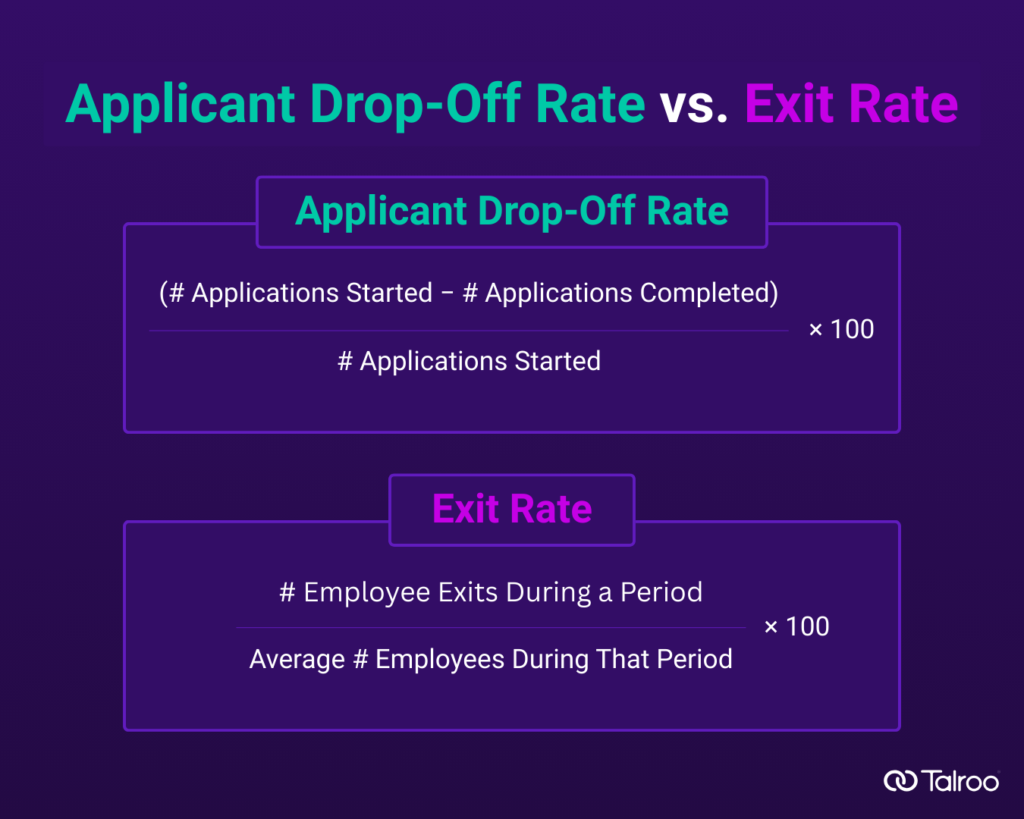
Monitoring both metrics gives HR leaders a full picture of talent lifecycle health. High drop-off rates may indicate issues with application design, employer branding, or candidate engagement. High exit rates often signal challenges with onboarding, culture, or career development. Both require attention, but your interventions look different: one at the front end of recruitment, the other at employee retention.
Modern HR technology can be a game-changer in understanding and reducing applicant drop-off. Applicant Tracking Systems (ATS) and recruiting CRMs provide real-time data showing exactly where candidates disengage. For example, analytics may reveal that candidates abandon the application during the resume upload step or when asked to complete multiple long-form fields.
Here’s how HR tech can help:
With the right tools, HR leaders can act quickly to streamline the candidate experience and minimize drop-off, saving time and improving the talent pipeline.
Reducing drop-off starts even before candidates reach your application. Your job listing is often the first touchpoint in the hiring journey, and a strong listing can attract the right candidates and encourage completion. Here’s how HR leaders and hiring teams can make job postings more compelling:
1. Write Clear, Accurate Job Titles and Descriptions
Avoid jargon or overly creative titles that may confuse candidates. A clear title helps candidates self-assess fit quickly. In your description, focus on essential responsibilities, required skills, and what success looks like in the role. Clarity reduces drop-off from mismatched expectations.
2. Highlight Career Growth and Development Opportunities
Top candidates want more than just a paycheck. Include details about advancement opportunities, learning programs, mentorship, and professional development. Candidates who see a future with your company are more likely to complete applications.
3. Emphasize Your Employer Brand and Culture
Your job posting should communicate why your company is a great place to work. Include information about culture, values, and initiatives that matter to candidates. A compelling employer brand not only attracts talent but also reduces early exits after hire.
4. Include Benefits and Perks Up Front
Salary transparency is increasingly expected. Include competitive compensation and benefits information, such as health coverage, remote options, and flexible schedules. Being upfront with benefits helps candidates self-select, reducing drop-off.
5. Simplify Application Instructions
Make it easy for candidates to apply. Use ATS features like resume auto-fill, one-click applications via LinkedIn, and limit the number of form fields. Candidates are more likely to finish a concise, mobile-friendly application.
6. Optimize for Mobile Devices
Many candidates apply on their phones. Ensure your job posting and application process are fully responsive, intuitive, and easy to navigate on mobile devices. Mobile frustration is one of the top reasons for drop-off.
7. Use Engaging, Inclusive Language
Language matters. Avoid phrases that may unintentionally exclude qualified candidates. Highlight commitment to diversity, equity, and inclusion. Inclusive language signals a welcoming environment, encouraging more candidates to complete applications.
8. Show the Impact of the Role
Top talent wants to know their work will make a difference. Describe how the position contributes to the company’s mission, goals, or client impact. Candidates who feel their work is meaningful are more motivated to engage fully.
Once your job listings are live, it’s essential to continuously monitor candidate engagement. HR leaders can use ATS analytics and A/B testing to refine listings and application flows. Pay attention to metrics like time to complete an application, field abandonment rates, and conversion rates from posting to submission.
Engagement strategies include:
Regularly reviewing this data helps HR leaders understand what’s working, what isn’t, and where improvements are needed. Over time, this leads to higher completion rates, better candidate quality, and a more efficient hiring process.
Every candidate lost before submission is an opportunity missed. However, by leveraging HR technology, simplifying the application process, and optimizing job listings to highlight career growth, culture, and benefits, HR teams can reduce drop-off and attract higher-quality candidates.
A strong job listing paired with a user-friendly application process not only increases application completion rates but also lays the foundation for long-term employee engagement and retention.
If you enjoyed this article, you might also like:
Tagged with
Recent Posts
Categories
Tags