Trust has quietly become one of the most valuable currencies in recruiting, yet it is also one of the most fragile. Over the past few years, job seekers have been navigating an increasingly confusing and sometimes hostile hiring landscape. Job scams are more sophisticated than ever. Pay ranges appear and disappear. Candidate communication is inconsistent. Automated processes feel cold and transactional. The result is a steep decline in trust between candidates and employers.
We have entered a trust recession.
For employers, this shift is not just a reputational challenge. It is a competitive threat that directly affects applicant flow, offer acceptance rates, and long-term retention. Candidates are far more selective about the companies they engage with, and they abandon hiring processes quickly when something feels unclear or misleading. In this environment, transparency is no longer a nice-to-have. It is a core strategic advantage.
According to global consultancy Michael Page’s 2025 Talent Trends survey of 50,000 professionals, less than half of employees reported “high or total” trust in their organizations — demonstrating a significant “trust deficit” in workplaces today.
This post explores why candidate trust has eroded and offers a roadmap for rebuilding it through clarity, consistency, and communication. For organizations willing to lead with transparency, the payoff is significant: stronger applicant pools, higher offer acceptance, and a more resilient employer brand.
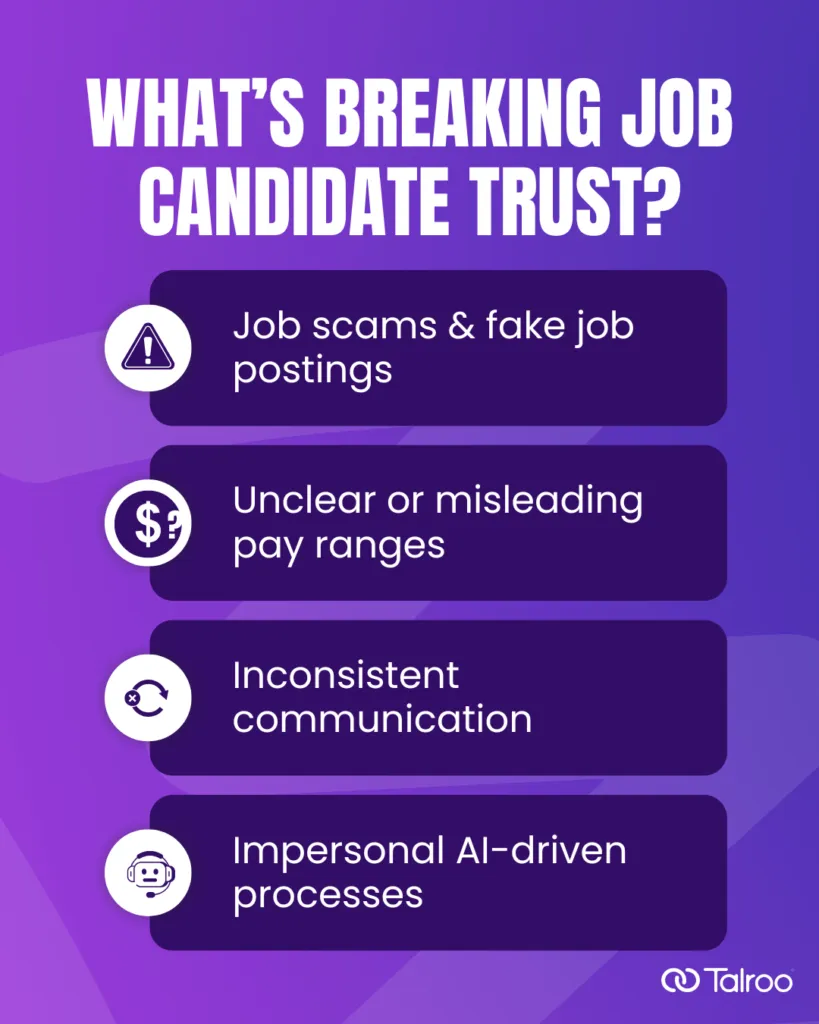
Today’s job seekers face a perfect storm of uncertainty. Several factors have accelerated this trust recession and reshaped candidate expectations.
Job scams and fake postings are on the rise. The Federal Trade Commission has reported year-over-year increases in employment-related scams. Fraudulent job ads now appear on legitimate job boards, social platforms, and even spoofed company domains. Candidates are more skeptical than ever, especially when a posting looks vague or a recruiter request feels unusual.
Employers with clear, complete, and verifiable job details immediately stand out because they reduce the cognitive load and emotional risk that candidates feel.
Unclear or misleading pay ranges. Pay transparency laws vary by state, and many companies publish wide salary bands that do little to guide candidate expectations. When ranges feel inflated, generic, or incomplete, job seekers see them as a red flag. They prefer employers who provide realistic compensation information and explain what influences placement within the range.
Candidates increasingly treat pay transparency as a proxy for organizational honesty.
Inconsistent or nonexistent communication. Delayed replies, unreturned messages, and vague timelines are among the top frustrations candidates report. In Talroo’s own marketplace, job seekers consistently note that reliable communication is a major factor in whether they apply or continue in a process.
Without consistent communication, even a positive hiring experience can feel unreliable.
AI-driven processes that feel impersonal. Automation can improve efficiency, but it can also create barriers. When every message looks like a template and candidates cannot reach a human for clarification, trust erodes quickly. Job seekers want to know that a real person is involved in key decisions and that their application isn’t disappearing into a black box.
When candidates do not trust the market, they gravitate toward the employers who feel stable, clear, and credible. Transparency accomplishes all three. Organizations that lead with openness benefit in several ways.
More qualified applicants. Clear expectations attract candidates who are both qualified and interested in the exact work, schedule, and pay offered. Transparency functions as a natural filter. Instead of chasing high-volume but low-quality applicants, employers see an increase in candidates who are aligned and engaged.
Faster hiring and fewer drop-offs. When job seekers understand the timeline, communication expectations, and interview structure, they feel more in control. This reduces anxiety and prevents drop-off during long or complex hiring processes. Transparency streamlines both the candidate experience and recruiter workload.
Higher offer acceptance and early retention. Candidates who feel informed are more likely to accept offers because there are fewer late-stage surprises. They start the job with accurate expectations, lowering early turnover. Transparency plants the seeds for long-term engagement.
A stronger employer brand. Employer reputation is built not only on what you say but on how consistently you say it. Transparent organizations stand out in job searches and on employer review sites because they demonstrate integrity. That credibility attracts candidates who value clear communication and honest engagement.
Reversing the trust recession begins with small, consistent actions. Employers do not need large budgets or complex tools to improve credibility. They need clarity, alignment, and follow-through.
1. Start with clear, realistic job postings
The job post sets the tone for the entire candidate experience. To build trust, focus on specifics rather than generalities.
Include:
Avoid generic language or phrases that overpromise. Specificity signals honesty and helps weed out mismatched candidates.
2. Publish and honor a transparent hiring timeline
Candidates want to know how long the process will take and when they can expect communication.
Provide:
Consistency here matters more than speed. Candidates are comfortable waiting if they know when the next update is coming.
3. Communicate often, even when there is no update
Silence is a trust killer. If your process is delayed or a decision is taking longer than expected, tell candidates. A simple message can preserve engagement and prevent frustration.
Template-driven communication is fine, but supplement it with personalized notes for top candidates. A small touch helps offset the impersonality of automated systems.
4. Provide transparency about tools and technology
If you use AI for resume screening, scheduling, or skill assessments, tell candidates what the technology does and what it does not do. Reassure them that a human reviews decisions that matter.
This openness reduces fear and positions your company as responsible and people-first.
5. Clarify expectations early in the process
Sharing details about the job’s realities helps candidates self-select and prevents future turnover.
Be upfront about:
Candidates appreciate honesty and will respect your organization for offering it.
6. Train recruiters and hiring managers on trust-building behaviors
Even the most transparent processes can fail if hiring managers operate inconsistently. Equip your teams with simple standards for communication, follow-up, and interview practices.
A candidate’s interaction with a hiring manager often becomes the biggest trust determinant in the entire process.
The Future of Hiring Depends on Credibility
The trust recession is real and it is reshaping candidate behavior across every industry. Job seekers are more cautious and more selective because they have been burned by unclear pay information, misleading postings, automated rejection cycles, and scams that look almost legitimate.
Employers who lean into transparency will outperform those who do not. They will attract more aligned candidates, reduce time to fill, improve offer acceptance, and strengthen their employer brand. Most importantly, they will build hiring processes that feel human again.
Trust is no longer an abstract concept in recruiting. It is a measurable business advantage. And in a competitive labor market, transparency is the most powerful tool employers have to earn it.
Recent Posts
Categories
Tags