Indeed Alternatives for High-Volume Hourly Hiring: What to Add Next to Indeed (2026)

Updated On
|
October 26, 2026
Author
|
Joseph Nyangwechi
Hiring stays hard while free reach on Indeed shrinks

Quick answer: If you hire hourly workers at scale across many locations, consider Talroo, a job advertising network, alongside Indeed. Talroo places your jobs on Jobs2Careers and partner job sites, and shows candidates your must-haves before they apply. For shift work, hourly job marketplaces such as JobGet and Snagajob also fit. For licensed roles such as CDL drivers and nurses, add a specialist board. Test before you switch: run the new source next to Indeed for 30 to 60 days. Then compare qualified applicants, hires and cost per hire.

Disclosure: Talroo publishes this guide and is one of the options listed. We describe every option from its own website or filings, linked inline. No one paid to be included.

Key takeaways

  • Indeed now makes more jobs pay to be seen. Each company gets up to 3 free posts a month made directly on Indeed. If your applicant tracking system (ATS) has an Indeed integration, you must post through it; jobs still sent by the older single-source feed show only when sponsored. Sponsored jobs are billed per click or per started application.
  • Keep Indeed and add one source that fits your hardest roles: a job advertising network or hourly job marketplace for volume, or a specialist board for licensed roles.
  • Test it on part of the budget in a few locations for 30 to 60 days, and judge it by cost per hire.
Hiring stays hard while free reach on Indeed shrinks: 68% of organizations reported difficulty recruiting full-time employees (SHRM 2026); Indeed allows 3 free direct posts a month per company; US job postings on Indeed are 4% above February 2020 (Indeed Hiring Lab, Oct 16, 2026)

What changed at Indeed in 2026?

Indeed has tightened its rules for free job visibility. Since March 31, 2026, some jobs submitted through older job feeds must be sponsored to appear. Jobs submitted through an Indeed-integrated ATS can still appear for free.

For employers hiring at scale, it's important to understand which jobs require a budget and whether other recruiting channels can help expand your reach.

Why do high-volume hourly employers look beyond Indeed?

Relying on one source is risky. When Indeed changes its rules or pricing, all your hiring feels it, and Indeed's own pages list several changes in 2026.
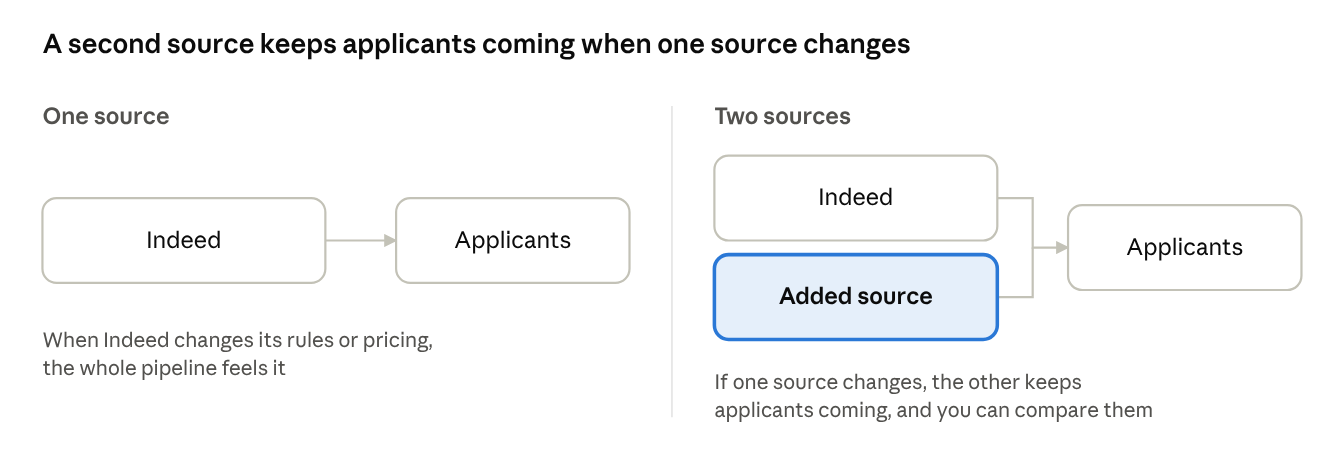
One source versus two: with only Indeed, a rules or pricing change hits the whole pipeline; with an added source, the other keeps applicants coming and you can compare them

Hourly roles also need a steady flow of applicants. People quit food service and retail jobs more often than jobs in most industries, so the same jobs open again and again.

Monthly quits rate, August 2026 (BLS JOLTS): accommodation and food services 3.5%, retail trade 3.0%, health care and social assistance 2.0%, transportation, warehousing and utilities 1.9%, construction 1.8%; all industries 1.9%

Turnover isn't rising overall (BLS JOLTS). But a job you refill often needs new applicants every month. A second source keeps that flow from depending on one site.

How do you choose an Indeed alternative?

Start from the roles that are hardest to fill, not from which site is most popular. The added source should fit those roles, your hiring volume and the locations you hire in.
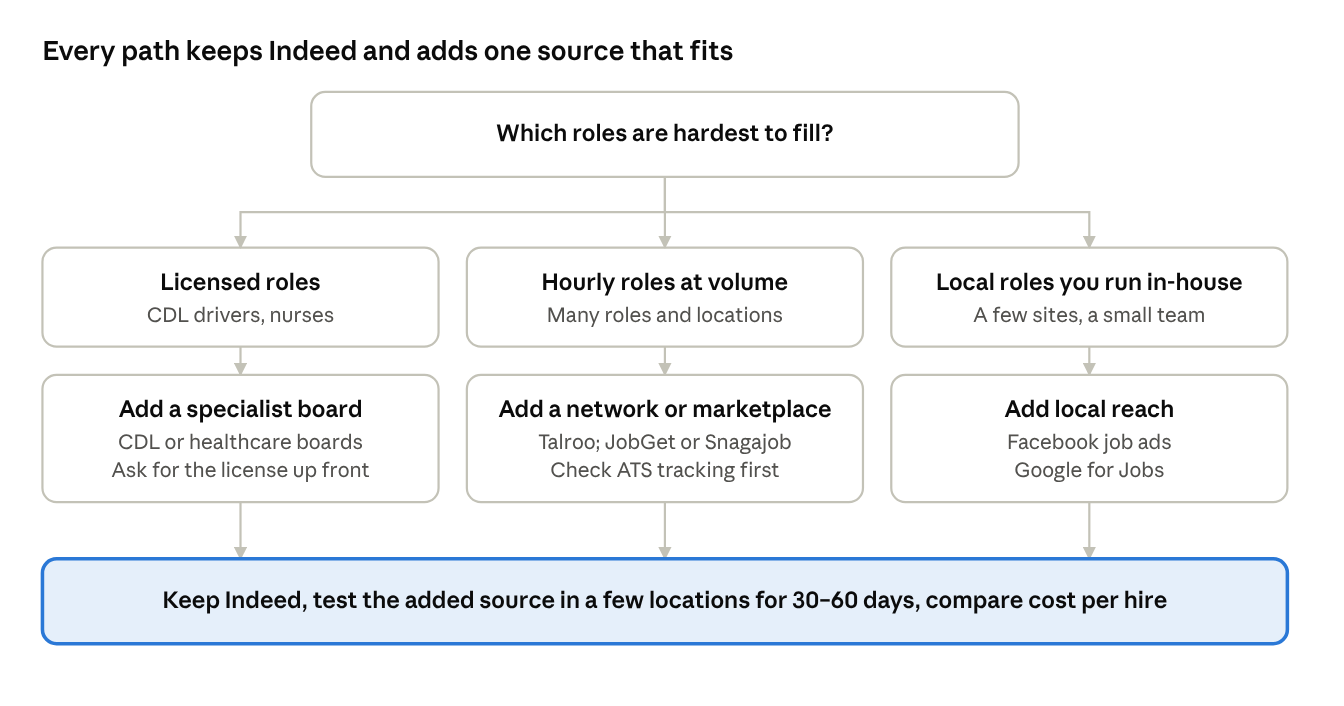
Decision flow: for licensed roles add a specialist board; for hourly roles at volume add a job advertising network or hourly marketplace such as Talroo, JobGet or Snagajob; for local roles add Facebook job ads or Google for Jobs. Every path keeps Indeed and tests the added source for 30 to 60 days by cost per hire

Before you sign, check four things:

  1. Role fit: does the source reach people who hold the license or skill the role needs?
  2. Volume and locations: can it run many jobs across all your locations without extra work per job?
  3. Tracking: do applicants arrive in your ATS tagged by source, so you can report cost per hire?
  4. Pricing model: can you test it on part of your budget, month-to-month?

What are the best Indeed alternatives for high-volume hourly hiring?

For steady hourly hiring across many roles and locations, the main options next to Indeed are Talroo, JobGet and Snagajob, and ZipRecruiter. The table compares them, using each company's own pages. Details on every option follow, grouped by the need it fits.

OptionBest fitReachScreeningATS connectionPricing modelWhat to test
Indeed (baseline)Most roles; the source to keepIndeed's site; jobs also show on GlassdoorScreener questions "at the start of the application," including required onesIntegrated ATSs must post through the integration3 free direct posts a month; sponsored jobs billed per click or per started applicationCost per hire by location as more jobs need sponsoring
TalrooSteady hourly hiring across many roles and locationsJobs2Careers and partner job sites "outside the big job boards"Candidates see pay, schedule and must-haves before they applyIntegrates with most ATSs; "no fee to integrate"Monthly budget from $2,000, month-to-monthQualified applicants and cost per hire in a few locations
JobGet and SnagajobShift work at employers with "50+ open roles""100M+ Everyday workers" across JobGet, Snagajob and SeasonedEach applicant "is evaluated against your role requirements" after applying"Plugs directly into your existing ATS"From "as little as $16 per day"; larger plans quotedShare of applicants who meet your must-haves
ZipRecruiterHiring across many kinds of rolesIts site plus partner job boards, search engines and social networksMatching that surfaces "the most qualified and interested candidates"Populates candidates into "certain third-party ATSs"Flat rate (a day to a year) or performance-based; quotedA quote for your volume, then cost per hire by source

Steady hiring across roles and locations

1. Talroo (job advertising network): covered in its own section below, "Why choose Talroo over another Indeed alternative?"

2. JobGet and Snagajob (hourly job marketplace)

  • Focus: hourly shift work; JobGet says it's "built for employers with 50+ open roles who hire at high volume."
  • Watch-out: JobGet positions itself for hourly workers, so if you hire licensed roles such as CDL drivers or nurses, ask how many license holders it reaches.

3. ZipRecruiter (job board with distribution)

  • Pricing model: no published list prices. Its annual report describes "flat rate pricing on terms typically ranging from a day to a year, as well as performance-based pricing."
  • Tip from our research: get a quote for your volume and track cost per hire by source.

Licensed roles

4. CDL job boards and driver-lead sites

  • Focus: carriers hiring truck drivers.
  • Reach: drivers who already hold a CDL.
  • Screening: the audience is pre-qualified by license; many sites sell leads (contact details) rather than applications.
  • Pricing model: per post, package or lead.
  • Watch-out: leads go cold fast, so call within hours.

5. Healthcare job boards

  • Focus: licensed nurses and allied health roles.
  • Reach: clinicians searching boards built for them, such as Health eCareers and Vivian Health.
  • Screening: the license filters the audience.
  • Pricing model: Health eCareers sells 30-day job postings (basic or enhanced) and sponsored postings; Vivian Health doesn't publish employer pricing.
  • Watch-out: weaker for CNAs, caregivers and home health aides.

Local reach you run yourself

6. Facebook

  • Focus: local entry-level, trade and service roles.
  • Reach: people who aren't searching job boards. Meta's free job listings, relaunched in the US in October 2025, cover "entry-level, trade, and service industry" jobs.
  • Pricing model: job ads by auction. Meta's employment ad rules allow no targeting by age, gender or ZIP code, and locations must cover at least a 15-mile radius.
  • ATS integration: none built in.
  • Watch-out: at volume, someone has to run campaigns and answer messages daily.

7. Google for Jobs

  • Focus: free reach for jobs on your careers site.
  • Reach: Google's job search results.
  • Pricing model: free. Per Google, JobPosting markup makes jobs eligible to appear.
  • ATS integration: works through your careers site or ATS.
  • Watch-out: needs technical setup, and placement isn't guaranteed.

Also considered: LinkedIn suits office and salaried roles more than hourly ones. Programmatic job ad platforms buy ad space across many other job sites and suit large teams with a media budget.

Why choose Talroo over another Indeed alternative?

Choose Talroo when you hire hourly workers every month across many roles and locations. Other options here also spread jobs across sites and connect to ATSs. What Talroo adds is the combination: job advertising across its own network, plus clarity before the apply, so the people you review already know what the job asks. The details, all from Talroo's website:

  • Reach beyond the big job boards. Talroo promotes your jobs on Jobs2Careers, ReadySetHire, Essential Worker Jobs and other sites "outside the big job boards." Talroo reports 60+ million worker profiles and 1+ billion job matches a month. Those are network totals, not unique monthly reach, so measure reach by the applicants you get in your own test.
  • Built for many roles and locations. Jobs sync from your ATS, and Talroo "integrates with most applicant tracking systems," with "no fee to integrate." You set a monthly budget from $2,000, month-to-month, and Talroo's team manages campaigns with you.
  • Clarity before the apply. Candidates see the pay, schedule, benefits and commute first, then the licenses and experience the role needs. Nurses and clinicians "confirm their license and experience up front." Those who continue reach your ATS already knowing what to expect.
  • Results customers describe.
    • Finish'd, a caregiving platform: in its second month with Talroo, 150 applicants registered and 90 met its eligibility criteria. Nearly all of them completed onboarding and could start work right away. The case study says the ads helped caregivers "understand the role's requirements before applying."
    • TransForce, which helps more than 400 customers hire commercial drivers: GM Erick Calderon said its qualifying process with Talroo "increased the number of quality candidates that we received, which was much greater than other job sources."
    • Choctaw Nation, which places about 5,000 candidates a year in restaurants, resorts, hospitals and farms: head of recruiting Robert Dromgoole said Talroo reached "audiences we weren't seeing elsewhere."

When Talroo isn't the best fit: if you make a handful of hires a year, Indeed's free direct posts may be enough. If you hire for one licensed specialty only, a specialist board may cover it. See how Talroo works.

Which Indeed alternative fits each hourly role?

Hard-to-fill roles each need a source built for them.

CDL truck drivers

  • Add: CDL job boards and driver-lead sites, or a job advertising network such as Talroo, whose network includes CDL Careers, to run driving jobs across your terminals.

Healthcare: nurses, CNAs and allied health

  • Add: healthcare boards such as Health eCareers for licensed nurses. Clinician boards are weaker for CNAs, caregivers and home health aides, so for those roles consider hourly-focused platforms such as Talroo or JobGet alongside a healthcare board. Talroo's SmartQualify for Healthcare has nurses and clinicians "confirm their license and experience up front."

Skilled trades: electricians and technicians

  • Add: a job advertising network such as Talroo, which promotes skilled-trades jobs, for steady volume across locations, plus local trade schools and apprenticeship programs for future hires.

Should you replace Indeed or add a second source?

Keep Indeed and add a second source. Running both side by side shows which one fills your roles at a lower cost, and Indeed keeps your hiring going while you test. Here's how:

  1. Keep Indeed running as it is. If your ATS has an Indeed integration, post through it. Indeed now shows single-source feed jobs only when sponsored.
  2. Pick a few locations and a mix of roles: your usual high-volume roles plus one or two hard-to-fill ones.
  3. Put part of the budget on one added source, for example $2,000 of a $10,000-plus monthly Indeed spend.
  4. Tag every source in your ATS, so each applicant and hire records where it came from.
  5. Run it for 30 to 60 days on the same jobs.
  6. Compare cost per hire (spend divided by hires), then move budget toward the lower one and add locations.
Illustrative example, not real results: Indeed $10,000 spent, 500 applicants, 20 hires ($20 per applicant, $500 per hire); added source $2,000 spent, 50 applicants, 5 hires ($40 per applicant, $400 per hire)

Cost per applicant can mislead. In this example, the added source costs twice as much per applicant but less per hire, because more of its applicants get hired.

Frequently asked questions

What's the best Indeed alternative for high-volume hourly hiring? For steady hiring at scale, such as 500 hires across 50 locations, keep Indeed and add a job advertising network such as Talroo. Talroo promotes jobs beyond the big job boards and connects to most ATSs. Hourly job marketplaces such as JobGet and Snagajob suit shift work, and CDL or healthcare boards suit licensed roles. Test for 30 to 60 days and compare cost per hire.

How does Indeed Sponsored Jobs pricing work in 2026? Indeed bills sponsored jobs per click or per started application, depending on your account and market. Its pay-per-started-application model uses a live auction, so costs depend on candidate demand, and qualifying jobs can't switch back to pay per click. Each company also gets up to 3 free posts a month made directly on Indeed.

Why did my Indeed jobs stop getting applicants? Check three Indeed policies first. If your ATS has an Indeed integration but you still send jobs by single-source feed, those jobs show only when sponsored; Indeed says to post through the integration. Jobs Indeed treats as duplicates can be hidden or shown lower. Free direct posts are limited to 3 a month and show for up to 30 days.

Should I replace Indeed or add a second source? Add one. Keep Indeed running, test one added source for 30 to 60 days, and move budget toward the lower cost per hire.

What's the difference between a job board and a job advertising network? A job board is one site where you post jobs and wait for applicants. A job advertising network promotes your jobs to job seekers across its own job sites and partner sites. Talroo, for example, runs jobs on Jobs2Careers and partner sites, and says it is "not a traditional job board where you post and wait."

Which Indeed alternatives qualify applicants before they apply? Talroo shows candidates the pay, schedule and must-haves before they apply, and nurses confirm their license up front. Indeed lets you add required screener questions, such as licenses or experience, at the start of the application and sort applicants by their answers. JobGet evaluates each applicant against your requirements after they apply. CDL and healthcare boards reach people who already hold the license.

Sources

Company and agency pages, opened October 26, 2026:

Recent Posts

Categories

Tags